



Gambia Clean Energy Roundtable
2 members
Loading...
Climate Live South Africa
6 members
Loading...
Gambia Clean Energy Roundtable
2 members
Climate Live South Africa
6 members

Feb 13, 2025
Legal
10 Mins
Afia Agyapomaa Ofosu wins “Resilience in Focus” award for capturing urban climate action
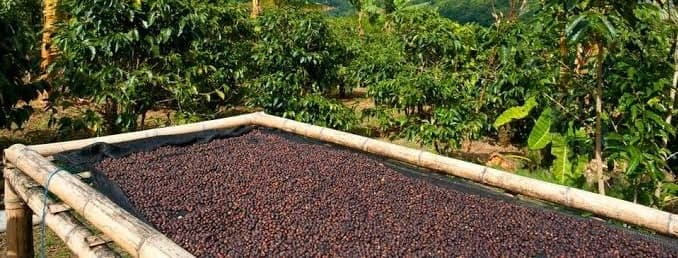
Coffee is the world's most widely traded tropical commodity. It supports a global market valued at nearly $250 billion annually and provides the means of subsistence for at least 12.5 million farming families in more than 70 countries.
Only 1–5% of the original cherry makes it into our cup, despite the fact that the entire coffee plant contains special bioactive compounds that are useful in a variety of products. This draws attention to a need to reduce waste and create value. Enhancing the coffee value chain throughout the Circular Economy.
For agribusinesses to improve resource efficiency, and generate value-added opportunities, circular practices are ideal. Opportunities for new products are presented by the size of current food systems, further promoting economic opportunity in the entire coffee value-chain.
Most conservation models treat biodiversity loss as a biophysical problem: habitat degradation, species decline, ecosystem fragmentation. But a growing body of work — including a recent push from the IUCN's Behaviour Change Task Force — argues that most threats to biodiversity actually originate in human decisions. Governance, incentives, individual choices. If that's true, then a conservation model built only on ecological variables is incomplete by design.
At Reserva Huaravito LTEMS, a 0.57-hectare premontane forest fragment in San Ramón, Costa Rica, this wasn't a new idea so much as a confirmation of a path we'd already been on.
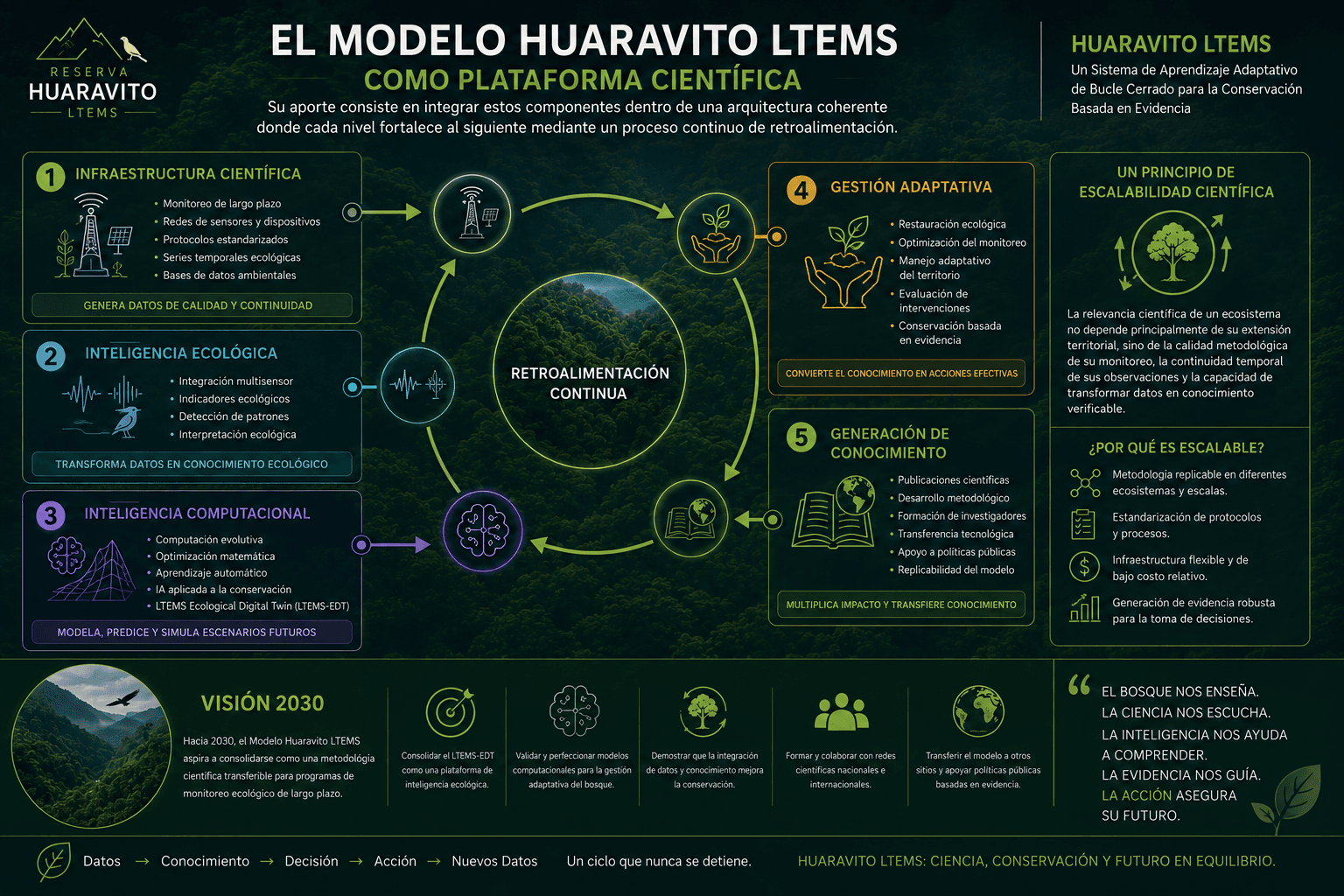
Since 2021, our reserve has operated as a long-term ecological monitoring system (LTEMS), generating continuous time series of bioacoustic, microclimatic, and phenological data. Over five years, that effort evolved into something we now call the RH-LTEMS Framework: a methodology built around an Adaptive Knowledge Cycle, where the forest generates signals, our monitoring infrastructure records them, computational analysis identifies patterns, and the resulting knowledge feeds back into management decisions.
Reading the behavioral science literature helped us see something we hadn't fully articulated: the tools we'd built — our monitoring system, our interpretive framework, our validation protocols — weren't really separate technologies. They were expressions of permanent scientific capacities. Observation, interpretation, simulation, validation, adaptive learning. The specific software or model behind each one could change without the underlying architecture losing coherence. That reframing matters, because it means the framework isn't dependent on any single technology — it's a structure that can keep absorbing new tools, including, eventually, behavioral and social variables, without being rebuilt from scratch.
For now, deliberately, we're not adding that human dimension yet. The priority is validating the ecological core first — proving, through a set of 2027 pilot studies, that the Adaptive Knowledge Cycle can actually close: prediction, decision, action, new observation, verified learning. Only once that's empirically demonstrated does it make sense to extend the framework toward what we're provisionally calling Adaptive Socioecological Intelligence — governance, visitor behavior, community participation, environmental education.
It's a small reserve making a fairly large claim: that scientific relevance doesn't come from the size of a protected area, but from the continuity and quality of what you monitor, and from a methodology disciplined enough to grow by evidence rather than by accumulating ideas.
Dear beloved Scholars,
I hope this message finds you well.
I am honored to share my work, The Climate of Civilization: History, Power, and the Universal Law of Earth’s Survival, with members of the IUCN CEM Social-Ecological Resilience & Transformation (SERT) community.
The work examines climate change through the widest possible civilizational lens, tracing the full climatic and human arc from approximately 300,000 BCE through the projected realities of 2050, 2100, and beyond. It places the current climate era within the broader history of human emergence, ecological stability, industrial expansion, population growth, energy systems, and planetary transformation.
For nearly 12,000 years, civilization developed within the relative climatic stability of the Holocene era. Agriculture expanded. Cities emerged. Nations rose. Economies grew. Science advanced. Modern civilization itself was built within this narrow climatic window. Today, humanity increasingly alters the very Earth systems upon which civilization depends.
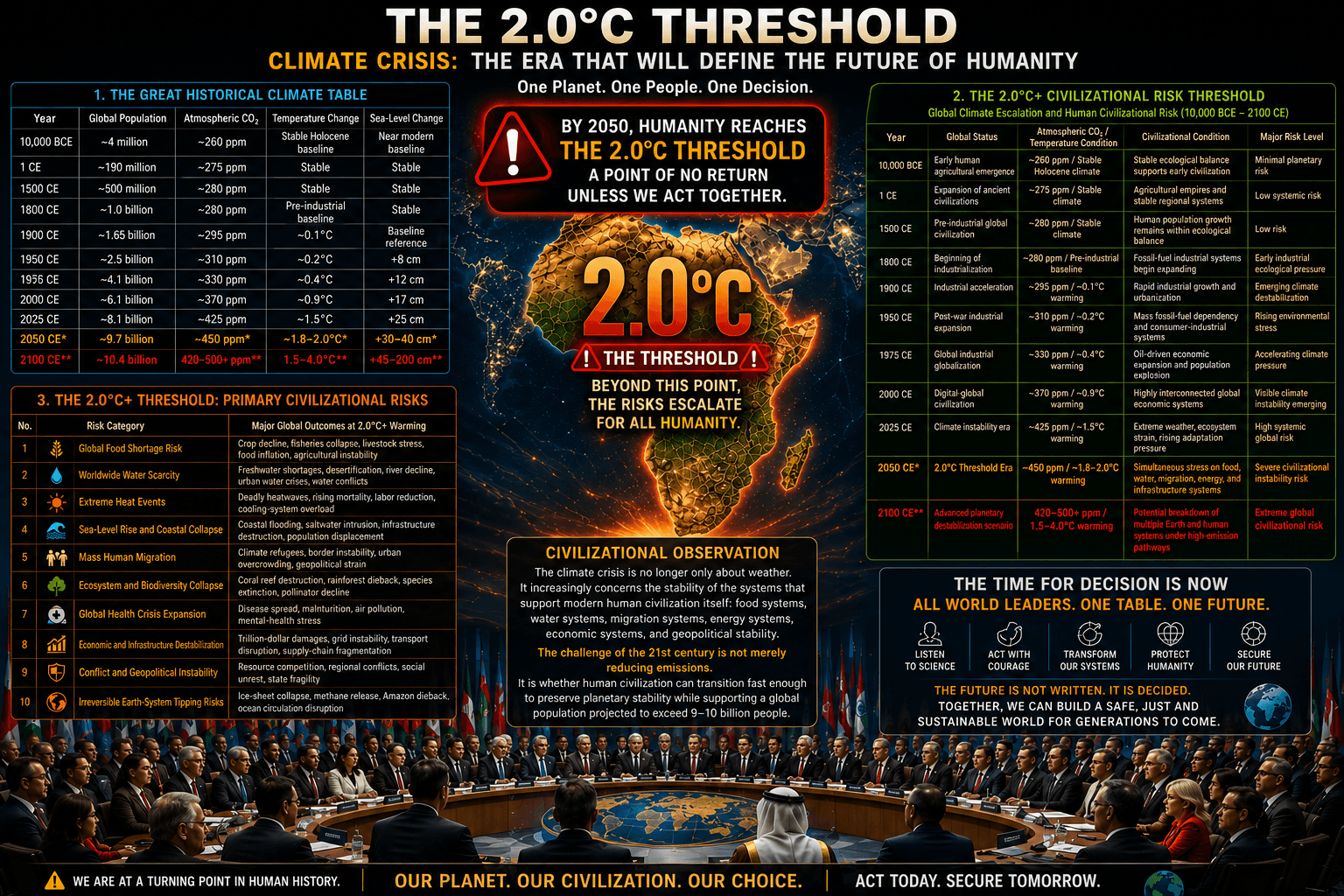
The book argues that the approach toward the 2.0°C threshold represents more than an environmental challenge alone. It increasingly becomes a civilizational threshold involving food systems, freshwater access, infrastructure, migration, energy systems, economic stability, ecosystems, governance, and geopolitical order simultaneously.
As stated within the work:
“Climate change is the largest ecological constraint modern civilization has ever encountered.”
The atmosphere does not respond to ideology, preference, or political division. It responds to physical reality.
At the same time, the work does not present the climate era only as a warning. It also examines the possibility that this century may become a turning point toward a new phase of planetary maturity and coordinated global stewardship.
The central argument is that the same pressures now confronting civilization may ultimately accelerate:
In this sense, the crisis itself is not the Golden Age. The response to it may become the foundation of one.
The attached visual presentation illustrates:
The work attempts to combine historical scale, systems thinking, climate science, civilizational analysis, and long-term planetary responsibility into one integrated framework.
Read the full work here: https://archive.org/details/the-climate-of-civilization-history-power-and-the-universal-law-of-earths-survival
The Climate of Civilization: History, Power, and the Universal Law of Earth’s Survival
I would be deeply honored by your thoughts, reflections, critiques, or scholarly observations.
One planet. One civilization. One shared future.
With respect and gratitude,
Adrianus Muganga


